.png)
Trump Faces Backlash From His Own Supporters Over Jesus Image, Iran Rhetoric, and a Week of Controversies
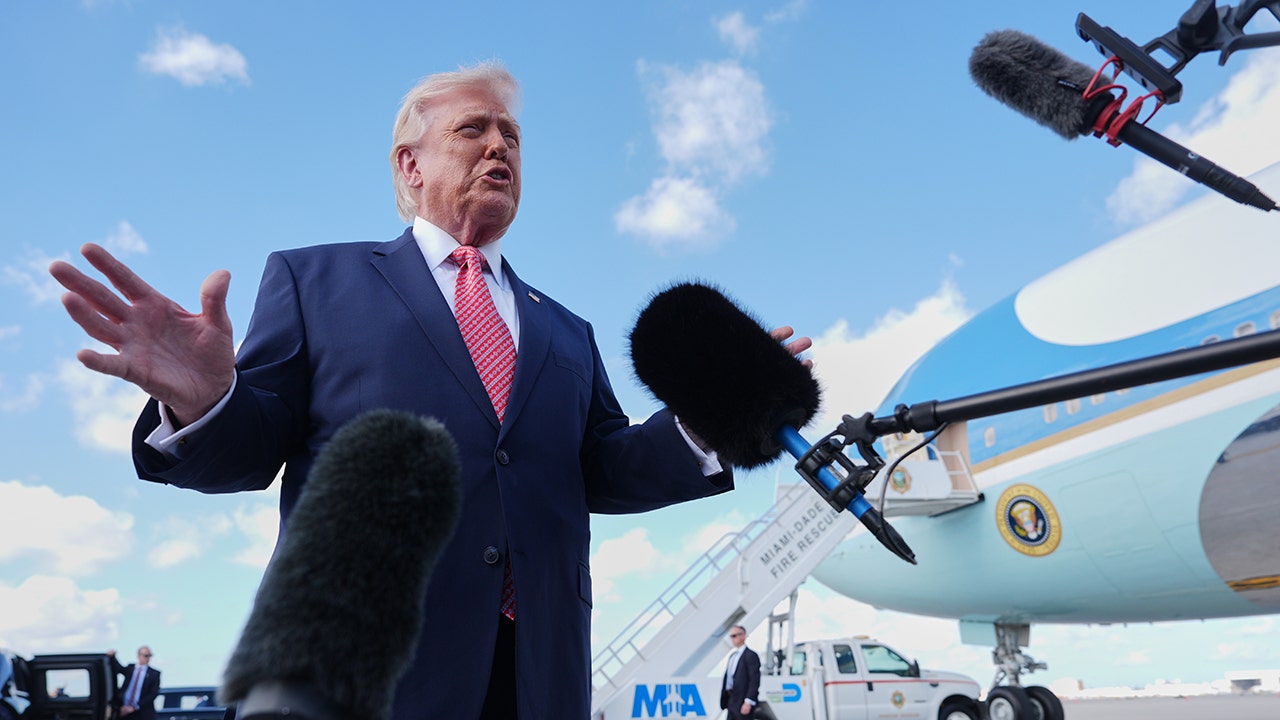
A string of controversial moves by President Donald Trump — from posting an AI-generated image depicting himself as Jesus Christ to threatening to end Iranian "civilization" — has triggered an unusual wave of pushback from his own supporters, raising questions about presidential rhetoric and restraint in an already turbulent political moment.
The backlash cuts across party lines and ideological boundaries, drawing criticism from Catholic leaders, conservative podcasters, retired generals, and even former White House insiders — a breadth of opposition that has thrust questions about Trump's judgment into the national spotlight.
The AI Jesus Image
The flashpoint that galvanized the most immediate response was Trump's decision to share an image of himself as Jesus Christ — an AI-generated graphic showing him in red and white robes typically associated with depictions of Christ, healing a patient with glowing hands, with a demon figure in the background. Trump deleted the post roughly 12 hours after sharing it, a rare reversal for a president known for standing behind his social media activity.
The criticism from conservatives was swift. Isabel Brown, a Catholic podcaster with the Daily Wire and a Trump supporter, called it outright unacceptable: "This post is, frankly, disgusting and unacceptable, but also a profound misreading of the American people experiencing a true and beautiful revival of faith in Christ in the midst of our broken culture."
Riley Gaines, a conservative podcaster and anti-trans activist who has spoken at Trump rallies, expressed confusion and disappointment: "I cannot understand why he'd post this…Two things are true…a little humility would serve him well" and "God shall not be mocked."
Megan Basham, a conservative Protestant Christian writer, went further: "He needs to take this down immediately and ask for forgiveness from the American people and then from God."
Religious leaders also weighed in. Rev. James Martin, editor-at-large of the Catholic magazine America, told CNN: "I don't know too many doctors that have glowing hands. That's the most Jesus-looking picture I think I could imagine."
When Trump attempted an explanation, saying he thought the image depicted him as a Red Cross doctor, few were convinced. "I thought it was me as a doctor, and had to do with Red Cross, as a Red Cross worker, which we support. It's supposed to me as a doctor, making people better. And I do make people better. I make people a lot better," Trump said. Vice President JD Vance offered a different explanation on Fox News, telling anchor Bret Baier: "I think the president was posting a joke. And, of course, he took it down because he recognized that a lot of people weren't understanding his humor in that case."
The image came just days after Trump publicly clashed with Pope Leo, calling him "weak on crime" and "terrible on foreign policy." The newly elected first American-born pontiff responded, saying "I have no fear of the Trump administration." It also follows an incident in February when Trump shared a video that ended with images depicting Barack and Michelle Obama as apes — something Trump said he missed and did not apologize for.
Iran Rhetoric and Military Escalation
Separately, Trump's language around the ongoing conflict with Iran has also drawn sharp criticism from both parties. Trump declared, "A whole civilization will die tonight, never to be brought back again," ahead of a self-imposed deadline for strikes on Iran's energy facilities — a deadline he then extended by two weeks.
That extension was not the first delay in the standoff. Trump has since announced the U.S. will target any vessel attempting to challenge an American blockade of the Strait of Hormuz, a waterway Iran has used to influence roughly one-fifth of the world's oil supply. Critics argue the moves have undermined a fragile ceasefire and that the administration launched military action without a defined exit strategy. Trump has maintained that America has already achieved a victory and can withdraw at any time, though his original stated goal — stopping Iran from enriching uranium for potential nuclear weapons — remains unmet.
The fiery rhetoric prompted former Trump ally Marjorie Taylor Greene to join Democratic calls invoking the 25th Amendment, and Trump's Iran threat sparked broader calls for his ouster, though at least one Democrat acknowledged the effort was "not realistic." Meanwhile, House Democrats unveiled a bill to examine removing Trump using the 25th Amendment, and House Democratic leaders opened the door to the 25th Amendment after rank-and-file members pushed for action. Removing a president under that provision requires a majority Cabinet vote and a two-thirds majority in Congress — a threshold no one expects to be met.
Fifty Democratic lawmakers filed legislation to create a formal commission to evaluate Trump's mental fitness. The Republican majority is expected to ignore it. Liz Peek, a Hill columnist and Fox News contributor, pushed back on those concerns: "Trump knows exactly what he is doing," adding that "Trump will continue to use maximalist (and sometimes outrageous) military and diplomatic pressure in his campaign to rid the Middle East of Iran's near 50-year campaign of terror."
A recent New York Times analysis noted: "President Trump's erratic behavior and extreme comments in recent days and weeks have turbocharged the crazy-like-a-fox-or-just-plain-crazy debate that has followed him on the national political stage for a decade." The White House rejected such assessments, saying Trump "is sharp and keeping his opponents on edge."
A Reuters/Ipsos poll conducted in February found that 61 percent of respondents believe Trump has become more erratic with age, while 45 percent said "he is mentally sharp and able to deal with challenges." Former White House lawyer Ty Cobb, who served during Trump's first term, has called him "clearly insane" — a characterization the administration disputes.
Swalwell Resignation and New Allegations
In a separate but significant political development, Democratic Rep. Eric Swalwell resigned his House seat amid sexual assault allegations after 13 years in Congress, following his earlier exit from the California governor's race. A full account of why Eric Swalwell was forced to quit the California governor's race details the mounting pressure he faced.
At a news conference, a new accuser, Lonna Drewes, came forward. Drewes said she met Swalwell in 2018 while working as a Beverly Hills fashion model and owner of a fashion software company. After two social meetings in which Swalwell offered to help her with professional connections, she said a third encounter turned violent. "I believe he drugged my drink. I only had one glass of wine. We were supposed to go to a political event and he said he needed to get paperwork from his hotel room. When I arrived at his hotel room I was already incapacitated and couldn't move my arms or my body." She continued: "He raped me and he choked me. And while he was choking me I lost consciousness and I thought I died."
Two other accusers, Ally Sammarco and Annika Albrecht, went on the record with CBS after Swalwell left Congress. "He thought he was untouchable," Sammarco said. "He acted with total impunity. He never thought that the consequences of his actions would follow him."
Also on Monday, Democratic Rep. Tony Gonzales announced he would resign his House seat, citing his faith: "There is a season for everything and God has a plan for us all." His resignation also came ahead of a high-stakes week for lawmakers as expulsion threats topped the House agenda.

